YouTube Brand Marketing Strategies: Learn Habits that Drive Hits
According to legend, someone once asked the famous thief Willie Sutton why he robbed banks. Said Sutton: "That's where the money is."
 Similarly, most video producers would probably tell you that they publish on YouTube because, "That's where the eyeballs are." YouTube also encodes your videos, creates an engaging player, allows you to embed the video into your own website, ensures compatibility with a range of target platforms, and pays all transport costs. If video distribution is integral to your marketing strategy, YouTube is an incredible bargain.
However, as countless producers have already learned, simply uploading videos to YouTube is no guarantee of marketing success. You have to upload the right videos, ensure they get found, take steps to ensure click-throughs back to your own website, and integrate these leads into a comprehensive marketing pipeline to ensure maximum value. In this article, I explore these issues with four publishers that have used YouTube to maximum effect.
Amerifirst Home Mortgage
AmeriFirst Home Mortgage specialize in FHA loans, VA mortgage loans, USDA Rural Development loans, home improvement loans and Conventional lending and has offices in 12 states. When the company hired Dan Moyle, a senior news producer from the local Kalamazoo news affiliate, it signaled that video was going to become very important to their marketing efforts.
Why are your videos on YouTube?
It's a no-brainer. Our target buyer persona is the first-time homebuyers who is typically 25-35. When folks in that age bracket have a question, they go to Google. Once there, YouTube results seem to appear in Google more than any other video service.
And we only use YouTube, we don't syndicate to other sites, which I think waters down the SEO impact. When I first started, we experimented by putting one video into over 100 channels, and saw no benefit in driving traffic, leads, or viewership. Since then, we've decided to keep the content focused, to not spray and pray.
How do you identify topics for your videos?
We identify questions that our prospects and customers are asking. One of the first steps I took when I got here was to ask the loan originators what questions are the prospects asking most often. We took the top ten questions and created videos that answered them.
We've also created a couple of series. One series is 60-second mortgage tips, which answer questions, responds to comments on the blog, or input from the sales team. Another series is the weekly housing market update, where we're trying to become a thought leader reaching agents and other lenders, which was a longer term project. We also tell client stories, not so much in testimonial mode about our products and services, but to show what they've accomplished, like improving their credit rating so they could buy a house, and buying a fixer-upper and converting it into a beautiful home.
We try to produce at least two videos a week -- the two series -- and one longer video a month, whether it's a client story, a topical story, or just a story interesting to potential customers, like what happens when you buy house at tax auction. We also produce occasional in-house corporate videos that aren't really for marketing purposes.
What's the target length for your videos?
In the broadcast world where I came from, the average length was 1:45 - 2:15. On the Internet, everyone says you have 6 seconds to grab a viewer's attention, but our most watched video (on HomePath loans) is 11 minutes long and has over 15,500 views. That said, we try to keep most videos in the 2-3 minute range, though if the story deserves breathing room, we'll go longer.
How do you get YouTube visitors back to your website?
All videos have a call to action, in both the description and the video, usually to a very context-specific link. We track how many viewers visit us from YouTube, and how many turn into leads. If you watch a video and click that deep link, you're much more likely to become a lead. the effectiveness of this traffic blows social media traffic away, and beats organic traffic as well.
How did you bone up on your YouTube related skills?
We engaged a company named Pixability (a consultancy that helps their customers succeed on YouTube) that taught us the best practices for tags, creating actionable titles and writing headlines for video. They also showed us other techniques to improve our SEO, and provided much better analytics for our videos than we get from YouTube. They've been a great asset.
What other techniques did you learn?
The hierarchy of SEO importance is titles and tags, which in YouTube are more important than the descriptions. When creating titles, we focus on the main idea conveyed by the video first, and get that to the front of the title. We don't shoot for cute and snappy titles, but functional and helpful.
Though there are no limit to tags, we learned very early to put the most important tags first. We put our brand-related tags well to the back, since few potential viewers ever search for us by name or product name.
What's the best background for video production?
You don't want to hire a high school kid to do your videos, you need someone with an eye for video and talent for storytelling, though they don't have to be a TV journalist. Find someone who's a good writer and good storyteller, and they should be able to produce good videos.
Tell me about your production gear?
Though I came from a television background, we started out with a little Panasonic consumer grade HD camera; nothing fancy, but it does have manual controls, which my cameraman uses. We also have a $300 compact fluorescent light kit and a couple of wireless lapel and shotgun microphones, not super high end, just good gear. The technology has come down so much in price, you don't need a Red camera to make high quality video. What's important is to have lights, mics and have a tripod - do it professionally - don't just grab your iphone and expect people to come back.
Any other advice?
Keep it simple and answer questions. Screw sexy, be helpful. Understand that what you have to say is interesting, and don't be afraid to leave in a little personality.
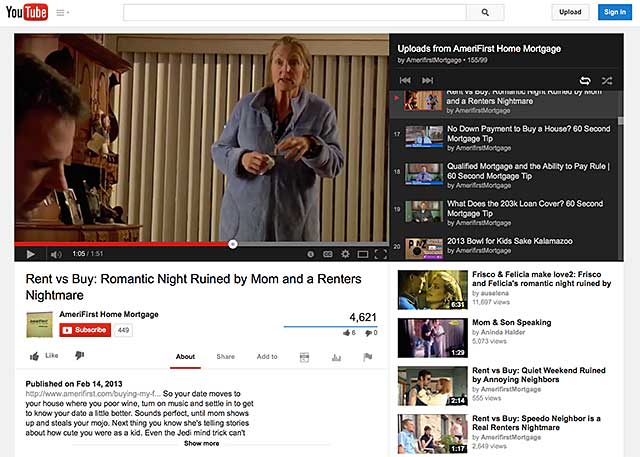 Amerifirst's Valentine's Day video sought to convince renters it was time to buy a home.
Ceilume Ceiling Tiles
Ceilume manufactures ceiling tiles and has been displaying videos on YouTube since around 2005, accumulating over 2 million overall views, with one video, Can I afford a Coffered Ceiling, garnering over 446,000 views. Where some hopeful marketers see YouTube videos as a panacea, Ceilume president Ed Davis sees it as just the starting point of the typical customer buying process.
How long have you been producing videos?
We've actually been producing videos since the 90's, primarily for training new employees. We started with ecommerce in about 2000, and then started posting videos online in 2005/2006.
Why did you start putting videos online?
Videos started as educational tools. Our ceiling tiles are thoroughly innovative products, and we wanted online customers to understand what they are buying. You can do a pretty good job of this with text on a product page, but we wanted to show it being handled, twisted and installed.
I liken it to the early, historical Sears and Roebuck catalogs I saw when I was a kid. The first 20 pages were on watches; not which one to buy, but how to understand what a good watch was. That's what we try to do with our videos, to educate our customers and help them make better decisions.
Where does YouTube fit into your overall marketing mix?
It's a critical component, but only the starting point. We track how prospects get to our site and their path through the site. Our average customer is a do it yourselfer, with about $1,000 to spend to replace the ceiling in a basement or small retail operation, to change the look without spending a lot of money. They might start by searching for ceiling tiles on Google or YouTube, which might lead them to our videos on YouTube. A video there might get them interested enough to visit our website, and if they're watching a product-specific video, an annotation or link in the video will usually take them directly to the product page.
On the website, we have to fill out the story, perhaps showing them how the tile is installed. We know that they'll probably visit our site, and others, several times -- they hardly ever buy during the first visit. We try to give them a little information each visit so by the time they decide to buy, they are thoroughly familiar with the product. In fact, if they try to buy the product without watching some of these product-related videos, we ask them to watch the videos, so they know exactly what they are buying.
What does YouTube give you that you can't get anywhere else?
In our view, YouTube is the second most popular search engine, and if people are searching for your product class, you have to be up in the rankings. That said, Google still rules the roost; it's where people really go first when searching for a product. If we had to give up YouTube or Google, we'd give up YouTube.
Describe your video production process.
I'd call it guerilla production. We've got a camera operator who's also the editor, and the actor who also wrote the script. So we can make a video very efficiently, for well under $500 considering wages and other costs.
That said, we're very aware that video quality matters. We have well over 2 million views on YouTube, but some of the videos are getting long in the tooth. When we first started producing videos, we were trendsetters, now competitors have caught up. To raise the bar, we just finished a new studio with a greenscreen and we've been upgrading all our production gear, from lighting to audio. This will allow us to refine our messaging, and produce a better class of videos.
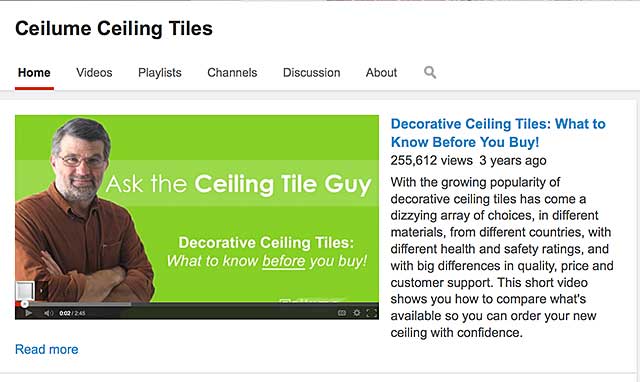 Ceilume president Ed Davis is the Ceiling Tile Guy on YouTube.
The Wall Street Journal
In addition to displaying videos on their own website, The Wall Street Journal (WSJ) has 11 channels on YouTube, populated with over 17,000 videos, which have garnered 277,000 subscribers and over 240 million views. I spoke with Andy Regal, who is Senior Executive Producer of WSJ's Digital Video Network. Before starting with WSJ in 2012, Regal worked in various roles with Big Lead Sports, CBS College Sports, MSNBC, Court TV and New Line Television.
Why did The WSJ start producing video in the first place?
The printed word is a beautiful thing, and we celebrate it here. But video brings a story to life in a way that printed works can't, it can tell story in a way that shows what's really happening on the ground. Video is crucially important, The WSJ was pretty early in adapting the notion, very forward thinking. We're certainly not perfect, but we feel like we're ahead of our competitors.
Why does the WSJ distribute on YouTube?
We have two overarching goals with our videos, to produce journalism fitting of the brand, and to distribute the videos as broadly as possible. That's why we distribute on YouTube -- it's evangelistic as it relates to The Wall Street Journal. It gives viewers a chance to experience our journalism and may encourage them to then buy a subscription. YouTube is a great platform for reaching new video consumers and hopefully new subscribers.
Are all the videos you post to YouTube the same as those on your site or different? If the same, do you post all of them, or just some?
We produce about 50 individual pieces a day. We used the kitchen sink approach when we first started on YouTube, posting all the videos, now we're curating and continually trying to refine what is working. For example, since we're a news organization, the videos on our site have to move along with the news of the day. YouTube gives us a better opportunity for the long term, with videos like celebrity interviews having a long tail on YouTube while being replaced on our own site by more trending or important news.
What types of metrics are you tracking on YouTube?
On YouTube, we want immediate gratification, videos that hit strong, like coverage of Malaysia Flight 370, or the White House Correspondents Dinner. But obviously, we also look at traffic over the long term.
On our own site, we look at both traffic and engagement. Sometimes a great headline may get lots of views, but engagement -- or how long people stay -- is a more important metric there.
What makes a great video on YouTube?
On YouTube, being the first to market matters, and when a story is breaking, that helps views a lot. Beyond that, we try to tell a great story that's interesting to watch, to take people where they can't go themselves. We try to make people feel smarter, to create stories that will put a glow back on them if they share it with their friends and colleagues.
We have a unique advantage, with over 1800 reporters, we can break journalistic stories that others can't, taking people to places they haven't been and providing insights they otherwise wouldn't have. We also focus on getting it right -- credibility matters -- and our viewers believe that what we tell them will be the truth.
What's your target video length?
YouTube statistics show that if you tell a great story -- produce great journalism with a strong visual component -- viewers will stick around and watch. So we don't artificially dictate the length of our videos; that's determined by the visual strength of the unique story that we're trying to tell.
The formula for YouTube success is a work in process that we continue to refine and experiment. We know that viewers like short answers, that are very visual, with lots of data, and also very timely. For example, we worked with our reporters to create short videos answering common questions about Malaysia Flight 370, and the YouTube audience really liked that. We've also noticed that viewers are more willing to share shorter videos in the 2:00 - 2:30 range.
Where do your video producers come from?
Many have been here for more than 10 years and grew up with our video production efforts. Some come from a traditional TV background, some from international, some from print. All have very strong journalistic backgrounds, and spend more time focusing on journalism than anything else. That's the key skill they all share.
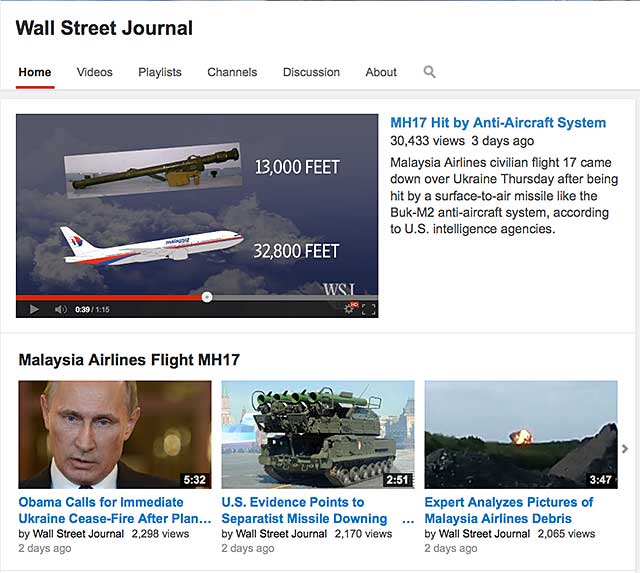 The Wall Street Journal uploads up to 50 videos a day to YouTube.
Wheelock College
Located in the Fenway neighborhood in Boston, Wheelock College focuses on professions that improve the lives of children, from birth through the fifth grade, predominantly graduating with degrees in social work, juvenile justice and education, and also several liberal arts degrees. Director of Marketing Stephen Dill, who previously worked in a variety of consulting and corporate positions, including as VP Interactive Marketing at State Street Interactive, relies heavily on YouTube and other social media sites to differentiate his institution from the hundreds of others seeking the same incoming class.
When did Wheelock start publishing on YouTube?
I got here in 2011, and we were already on YouTube, but there was no strategy, there was lots of video but it wasn't well aimed.
How did you change that?
We decided to focus on three types of videos; institutional videos that describe who we are and what we have to offer; program videos that describe how we do what we offer and individual videos that describe who we are as individuals, students, faculty, and alumni. And we decided to try to produce primarily short form videos in the 1-3 minutes range, particularly for the individual videos.
Describe how your use of YouTube evolved.
We started with six videos that seemed to get a good response, and over the next year added about 25 more. A local TV affiliate produced an institutional level video about our mission, students and faculty. Then we created a 3.5 minute animated video that does a great job telling the story of Wheelock. We hooked up with Pixibility (a consultancy that helps their customers succeed on YouTube), ran some YouTube ads that pointed to the video, and had 12,000 views in a very short period of time, with a 31% click-through rate to our website.
That convinced us that a good story, well told could be a very effective tool, and that YouTube's search engine value was huge, particularly among our target demographic. Now we're producing about 60 videos a year.
What's the ideal video length?
More and more data coming out of YouTube shows that viewers will watch longer videos if the content is good and many of our videos bear this out. That said, 65% of our videos that are 60-90 seconds in length get watched all the way through, while there's often a significant drop off with longer videos. For this reason, we still try to be concise and accurate, and get the story told as efficiently as possible.
How do you choose your topics?
About 15-20% are topical, say a conference, speaker or lecturer. Another 30-35% relate to large events, like commencement, convocation, move-in day and acceptance day. The balance is spread evenly around the other programs, making sure there's a good mix of content supporting all the programs.
How do you make sure your YouTube videos are watched?
We rely on Pixability for guidance and use their methods; we upload to Pixability first, who then uploads it to youTube. From there, we are very aggressive with social media, with multiple accounts on Facebook, Twitter, YouTube and other services, posting 4-6 times daily, so each video gets multiple mentions from multiple sources.
How do you ensure click throughs to your website?
All descriptions have links at the very top. Many videos have annotated calls to action throughout and with our longer videos, we have an annotation that pops up right around the time we start to see significant drop off. Most links are deep links to specific pages on our website related to the content of the video, which helps make sure that potential students get the information they're looking for. In the last month's report, we had 765 click throughs on these links, which is a great number for an institution with around 1,400 total students.
How would you describe your production value?
We have an on-staff videographer who produces with high end DSLR from Canon and BlackMagic Design. It seems like every shoot he produces has three to five cameras, and he delivers a very high production value.
This year we're formulating our first student social correspondents core with iPads to provide a ground level view that non-students never really see. We'll give them the tools and training to craft stories describing what it's like to be a student at Wheelock in Boston. We'll treat them like journalists with an editorial board to review materials and give them assignments.
These stories are targeted at 15-20 year olds, where production value isn't the issue. We think that if the student core produces fun, compelling stories, even if with wavering iPad, it will still get desired effect.
What are the results of your video program?
It's tough to say because lots of things changed at once, including our branding and admissions process. But since 2011, we've had a 38% increase in students and we have reliable traffic data showing the many of the visitors come from YouTube. We've had a 27% increase in website traffic month over month.
Beyond this, there's a component of the value in the increase in moral that the videos bring. Our students, faculty and alumni love seeing themselves in the videos, it makes them feel good about this institution they've invested so much in. It's more ephemeral than click through rate, but it's just as important.
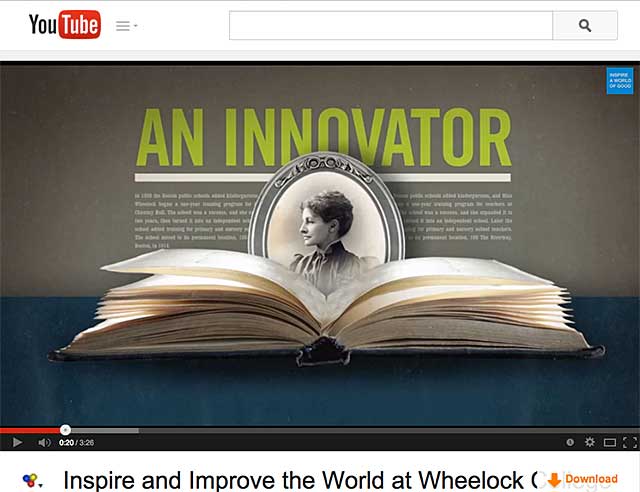 This animated video had a 41% click- through rate to the Wheelock website.
This article appears in the September 2014 issue of Streaming Media as "Getting the Most Out of YouTube."
Jan Ozer's article first appeared on OnlineVideo.net
Companies and Suppliers Mentioned