Apple's HD Streaming Gamble
Yesterday's live stream of Apple's annual music press conference might be a leading indicator of a few of the challenges that consumers will face with the new Apple TV and AirPlay streaming solutions.
As mentioned in Troy Dreier's article and Dan Rayburn's blog post, the overall quality of the live stream was much better than Apple's last attempt at a live stream several years ago. Yet there were also a few issues; I'll address the ones I encountered, using those insights to address a larger gamble Apple will face with the new streaming-only Apple TV.
The Good, the Bad, and the Ugly
Encoded on Inlet Technologies' Spinnaker, the image quality from Apple's live event was good enough on a 3G connection on the iPhone 3GS that I was able to watch the first five minutes of Apple's CEO Steve Jobs presentation via a 3G connection. After a few minutes, however, network congestion forced the iPhone viewing back to an audio-only stream, with the video replaced by a warning screen about limited bandwidth.
Switching over to a Wi-Fi connection, the image improved considerably, meaning that Inlet's encodes were working in the adaptive bitrate (ABR) method they were intended to for Apple's HTTP Live Streaming. The image was so sharp that I continued to watch on the iPhone, since it was convenient to view this "small monitor" placed next to my Macbook Pro while I took notes on the laptop.
Within the first 20 minutes, however, black frame glitches began interrupting the stream consistently every 7-8 minutes. To verify it wasn't an iPhone issue, I switched over to viewing the live stream on my laptop, also connected via Wi-Fi, at about 40 minutes into the presentation.
On the laptop, I viewed a stream of very high quality, but the black frame glitches continued consistently every few minutes. At one particular point, the stream on both the iPhone and the Macbook Pro switched to pre-event video, as if the event were starting over.
At the very end of Coldplay frontman Chris Martin's final song, a work in progress titled "Wedding Bells," the video went into a loop where it continued to play the same 24 seconds. After letting it run that way for five times, I finally refreshed the Safari 5 browser window, which started the video back at the the pre-event video. I never was able to see the final few minutes of the video, even scrubbing back down the timeline.
Prior to the event, GigaOm's Om Malik posited in one of his articles that Akamai, the CDN streaming the event, would see a significant spike in traffic on its real-time visualization tool.
"Akamai displays a real-time visualization of its active streams," said Malik, "and breaks out live streams specifically. I'm expecting we'll see a significant bump from the current total global live streams powered by Akamai - currently a bit under 600,000 - right at 10 a.m. PT."
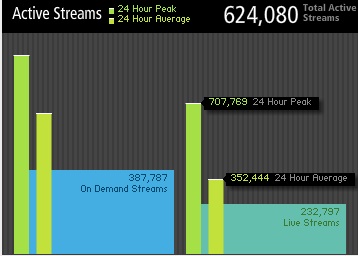
Checking the visualization stats a few hours after the event, the peak live streams for a rolling 24-hour period had only risen from the 600,000 range to 707,769 live streams.
The page views per minute for HTTP traffic showed a somewhat bigger rise to a 24-hour peak of 36,614,383 right about the 1 p.m. Eastern starting time, from an average of approximately 33,000,000 page views per minute in the two hours preceding the event.
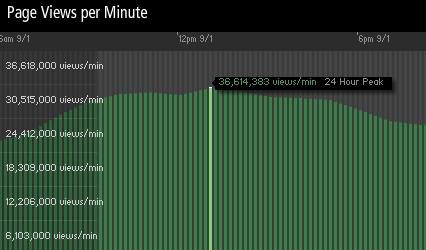
This means, until further confirmation, projections for the event are that either roughly 107,000 viewers viewed the live streams, or approximately 3.5 million viewers simultaneously hit Akamai-powered sites.
Related Articles
Apple's built-in video player gains the ability to merge multiple clips and export an audio file.
22 Jul 2011
Will Apple's redesigned Apple TV be the one to stand out to buyers this holiday season?
01 Sep 2010